
What Is Ballast?
Ballast is an electrical component used with certain lighting systems to control current and help a lamp start and operate correctly. Traditional fluorescent fixtures use magnetic or electronic ballasts. Some LED retrofit lamps require a compatible ballast, while other LED systems bypass or remove the ballast and connect to an LED driver or line voltage.
Quick Facts About Ballast
Category
Lighting control component
Used for
Fluorescent and compatible LED fixtures
Common confusion
Ballast versus LED driver
Also called
Light Ballast, Fluorescent ballast
Often discussed with
Indoor Lighting Installation, LED Lighting Installation
Key Takeaways About Ballast
- A ballast belongs to the lighting circuit, not the lamp itself.
- Ballast compatibility affects fluorescent and some LED retrofit installations.
- A ballast is not the same component as an LED driver.
How Ballast Works

A ballast manages electrical current through a compatible lamp. A fluorescent lamp needs controlled current after starting, because its electrical resistance does not limit current in the same way as a standard incandescent lamp. Magnetic ballasts use coils, while electronic ballasts use electronic circuits to control the lamp more efficiently and quietly.
Related glossary terms: LED Driver, Line Voltage, Power Factor.
Lighting work begins with identifying the fixture, lamp type, and ballast design. The lamp label and ballast label must match the intended system. Some LED retrofit lamps operate with an existing ballast, while ballast-bypass lamps connect directly to supply conductors. An LED driver serves a related purpose in many integrated LED fixtures, but it is designed for LED electronics rather than fluorescent tubes.
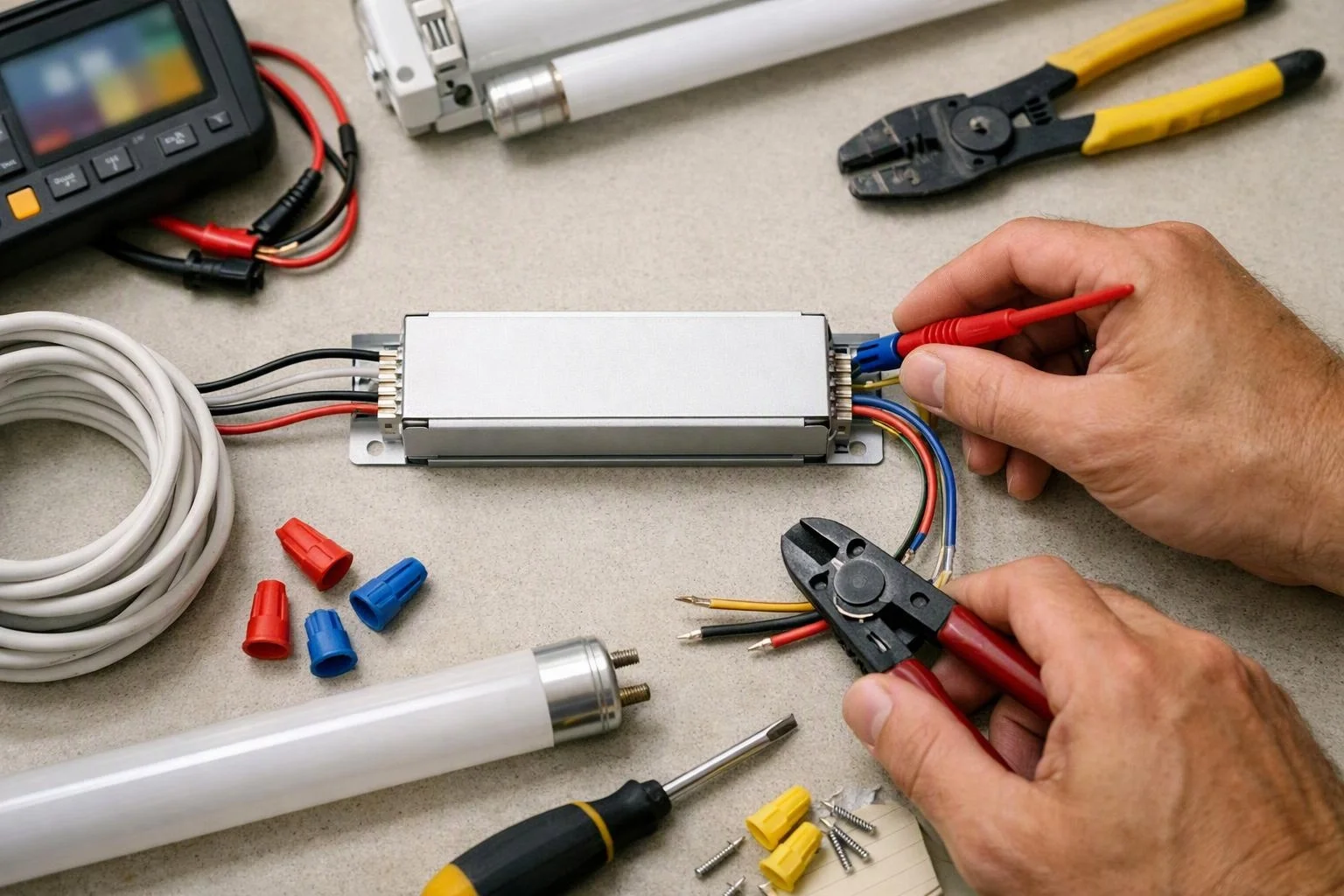
From the Service Electric team
When we inspect a ballast during indoor lighting installation, we check the fixture label, lamp compatibility, wiring condition, and signs of heat or failure. We also determine whether the planned LED system keeps the ballast or requires a different connection method. That check helps prevent mismatched components and unexpected lighting problems.
Ballast in Practice: A Real-World Example
A fluorescent ceiling fixture has lamps that flicker and fail to start consistently. During an indoor lighting installation, the ballast and lamps are checked together to determine whether the fixture needs a compatible replacement or an LED conversion.
Related Terms
LED Driver
An LED Driver is an electrical device that converts incoming power into the controlled current or…
Line Voltage
Line voltage is the electrical potential supplied directly by a building’s branch circuit to power equipment…
Power Factor
Power Factor is a measure of how effectively an electrical load converts supplied power into useful…
Service Electric
Have Questions About Ballast?
Contact Service Electric for practical guidance on Ballast and related 24 hour electrician work in Victoria.